When an inspector, insurer or enforcing authority asks what has been done to manage fire risk, verbal reassurance is not enough. You need a clear record that shows what was found, who acted, when work was completed and why the building is now safer. Knowing how to document fire compliance evidence turns a stressful challenge into a controlled process.
For duty holders, weak records can create the same pressure as unfinished work. A fire door may have been adjusted, a penetration may have been correctly sealed, and a risk assessment may have been reviewed – but if the evidence is scattered across inboxes, photographs and invoices, it can be difficult to prove. That leaves your organisation exposed when scrutiny arrives.
Evidence must show more than a completed job
Fire compliance evidence is the trail connecting a building risk to a verified action. It should allow another competent person to understand the issue without relying on memory or assumptions. In practical terms, the record needs to show the location, defect, risk, corrective work, responsible person, completion date and supporting proof.
A certificate on its own rarely tells the full story. It may confirm that work was undertaken, but it will not always identify the precise doors, service penetrations or compartments affected. Equally, a collection of photographs without dates, locations or descriptions may look thorough but offer little assurance under inspection.
The strongest files tell a straightforward story: the survey identified a problem, the duty holder assessed and prioritised it, competent people completed the work, and the result was checked and signed off. This protects occupants first. It also gives building managers a defensible, practical response when regulators, insurers, residents, governors or senior leadership ask difficult questions.
How to document fire compliance evidence properly
Start by deciding what you need to prove for each building, rather than collecting documents for their own sake. The exact record will depend on the premises, its use, the people at risk and the work carried out. A care home, for example, needs particularly clear evidence around escape routes, compartmentation and the capability of residents to evacuate. A school may need records that demonstrate controls remain effective as layouts, staff and occupancy change.
Build a reliable baseline
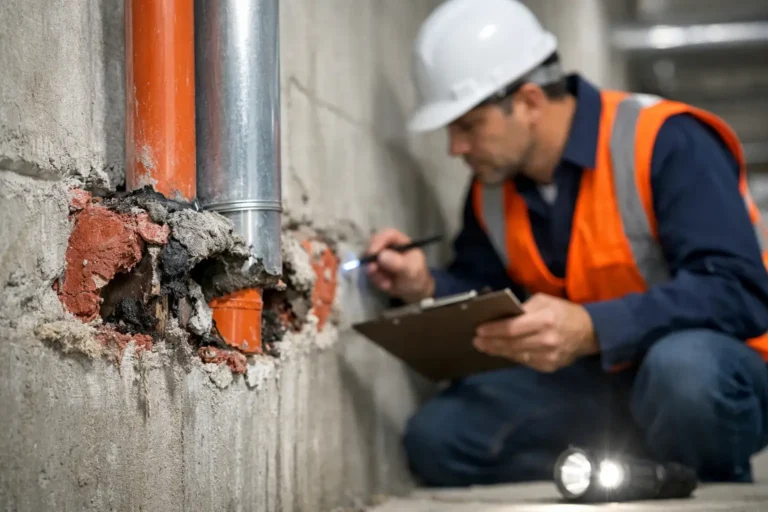
Create a current asset and risk record before remedial work begins. This gives every later document a reference point. For fire doors, record the unique door reference, floor, room or zone, door type where known, defects identified and photographs of the condition. For fire stopping, identify the compartment line, penetration type, services passing through and the condition of the existing seal.
Use a location system that makes sense to people on site. “Third-floor east corridor, FD-3E-14” is useful. “Door by the stairs” is not. Consistent references prevent confusion where buildings have multiple wings, repeated room numbers or several similar doors.
Your fire risk assessment should also be current and available alongside this technical evidence. It establishes the wider context: people at risk, evacuation arrangements, significant findings and required actions. Do not treat a risk assessment as a document that can sit untouched for years. Review it when the building, occupancy, work processes or fire precautions change, and record why the review was undertaken.
Record defects with enough detail to act
A defect log should be specific enough for a competent contractor to understand the problem and for a manager to prioritise it. Avoid vague entries such as “fire door damaged” or “fire stopping required”. State what is wrong, where it is, what standard or intended performance it affects, and the action required.
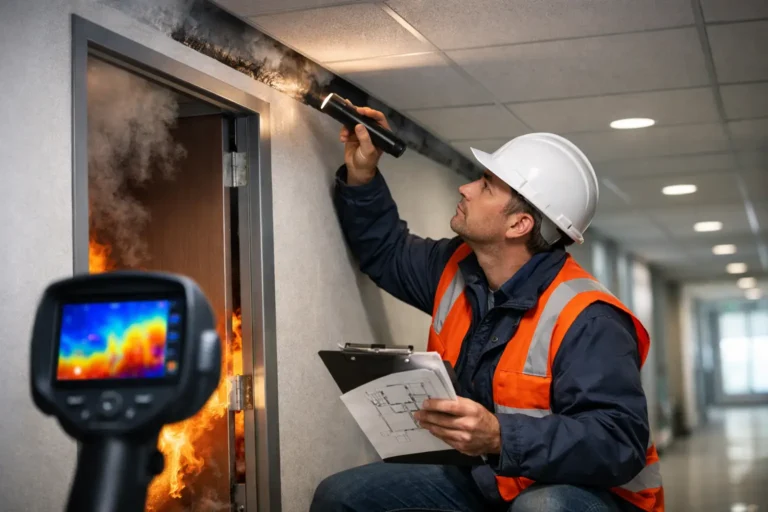
For example, a useful fire door record may identify an excessive perimeter gap at the head, damaged intumescent seals, a non-latching leaf or an unprotected vision panel. A useful fire stopping record may identify an open penetration around data cabling in a compartment wall, with no tested system evident.
Photographs strengthen this record when they are clear, dated and tied to the location reference. Take a wider image to establish the setting, then close-up images of the defect. Where practical, include a scale or measurement. Poorly lit photographs taken from too far away do not provide meaningful proof.
Link every action to a responsible person and date
Once a defect is identified, document the decision made. Was it made safe immediately? Was it assigned for urgent repair? Has a temporary control been introduced while specialist work is arranged? The record should show the owner of the action, target date, priority and current status.
This is where many compliance files fail. They show that a survey took place but cannot demonstrate whether recommendations were completed. An action tracker closes that gap. Keep it live until every item is verified, not merely until a purchase order is raised or a contractor confirms attendance.
Where a risk cannot be removed immediately, record the interim control and review date. It may be appropriate to restrict use of an area, increase checks, improve housekeeping or provide a temporary management measure. The right response depends on the risk. What matters is that it is justified, communicated and not allowed to become a permanent workaround.
Keep evidence of remedial work together
After work is complete, attach the completion evidence to the original defect record. This should include the scope of work, materials or systems used where relevant, photographs after repair, installer details, dates and any certification or test documentation.
For fire stopping, evidence should identify the tested or specified solution used for the particular service penetration and substrate. Generic statements that an area has been “fire sealed” are weak, especially where later alterations may affect the compartment line. For fire doors, records should show the specific adjustments, replacement components or remedial works undertaken rather than relying on a broad invoice description.
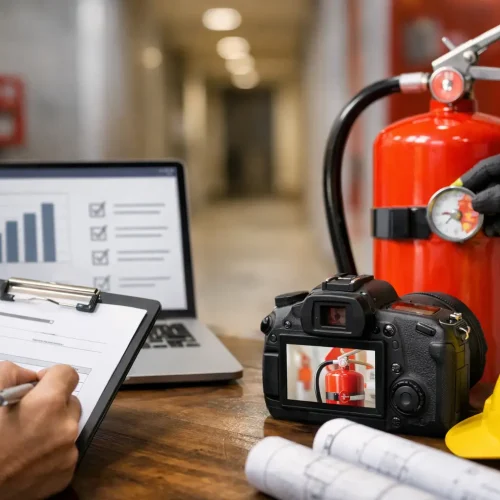
There is a trade-off between capturing every detail and producing a file that nobody can use. Do not bury essential proof in hundreds of unlabeled images. Use a consistent naming convention, such as building, location reference, work type and date. A well-organised folder or compliance platform should allow you to retrieve the complete history of one door, riser or compartment within minutes.
Certification matters, but verification matters too
Competence is central to credible fire safety evidence. Keep details of the contractor or assessor, their relevant competence, scope of inspection and limitations of the work. If an inspection could not access a void, riser or occupied room, record that limitation and arrange follow-up. An inaccessible area is not automatically compliant because it was omitted from the report.
Certification should be retained where it applies, but it must match the work undertaken. Check that names, addresses, dates and location references are correct before filing it. A certificate with the wrong building address or no usable scope can create uncertainty rather than remove it.
Independent verification is especially valuable for higher-risk or extensive remedial work. A post-work inspection gives the duty holder confidence that the repair has addressed the original problem. It also identifies poor workmanship before it becomes a hidden liability behind finishes, ceiling voids or service risers.
Make records inspection-ready all year round
Evidence should not be assembled only when an audit is announced. Build documentation into everyday management. Set review dates for open actions, repeat inspections, fire door checks, alarm and emergency lighting testing, staff training and changes to the building fabric.
Keep the current documents separate from superseded versions, but do not delete the history. Older records can explain why decisions were made and demonstrate a pattern of active management. Restrict editing rights where possible, record who uploads documents, and back up files securely. A compliance record that cannot be found, opened or trusted is of little value when it matters.
The most common documentation failures are predictable:
- photographs that cannot be linked to a location or date;
- reports with actions but no evidence of closure;
- certificates filed without the related survey, scope or remedial record;
- repeated defects with no recorded escalation or review.
These gaps are avoidable with a single accountable process. FireBlocked365 helps duty holders connect detailed inspections, remedial works and documented sign-off, so the evidence is not left to chance between contractors and internal teams.
Your records should give you confidence before anyone asks to see them. If one fire door, one breached compartment or one overdue action cannot be traced from discovery through to verified completion, deal with it now – while you still control the timetable, the cost and the risk.