A fire compartment is only as reliable as its weakest service penetration. One unsealed cable bundle above a ceiling, a poorly repaired pipe opening or the wrong sealant around a duct can allow smoke and fire to bypass walls and floors designed to contain them. Fire stopping inspections are how duty holders find those failures before an assessor, insurer, regulator or, worse, a real fire exposes them.
For landlords, facilities managers, housing associations, schools, care homes and commercial building operators, this is not a paperwork exercise. It is a direct test of whether your building’s passive fire protection can do the job occupants depend on. The right inspection gives you a clear view of risk, a practical route to correction and evidence that stands up when questions are asked.
What fire stopping is meant to achieve
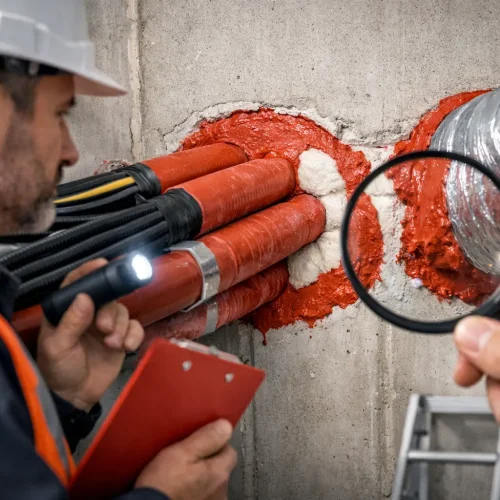
Fire stopping protects the openings created when building services pass through compartment walls and floors. Pipes, electrical cables, data cabling, ducts and structural joints all create potential routes for fire and smoke. Suitable systems are installed to reinstate the fire resistance of the separating element around them.
That principle sounds straightforward. The difficulty is that real buildings change. New IT installations, maintenance works, retrofit projects, heating upgrades and contractor access can all leave behind gaps that are out of sight and out of mind. In older premises, original installations may also be poorly documented, damaged or incompatible with later alterations.
A compliant fire stopping solution is not simply any material placed in a hole. It must be appropriate for the substrate, opening size, service type and required fire resistance. It must also allow for factors such as movement, insulation, pipe material and the number of services passing through. A seal that looks neat can still be unsuitable.
Why inspections reveal risks routine checks miss
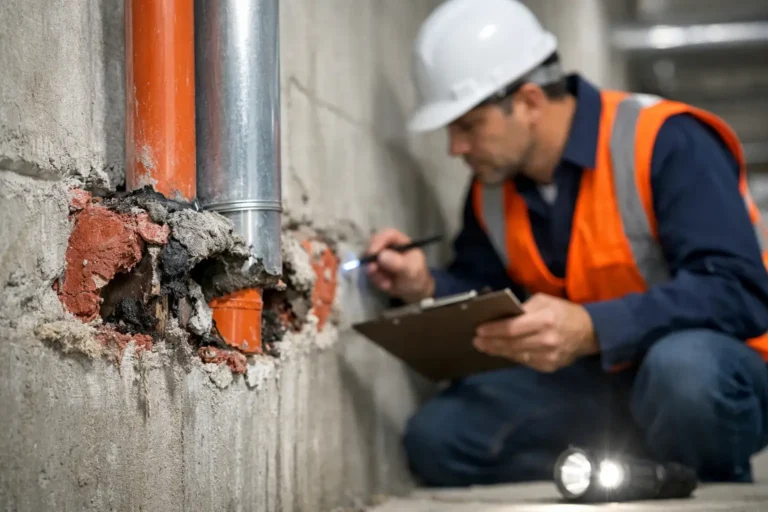
Many serious defects sit above suspended ceilings, inside risers, in roof voids, plant rooms, service cupboards and behind wall linings. They are not visible during a normal walk-through, and they are unlikely to be identified by a general contractor focused on a different job.
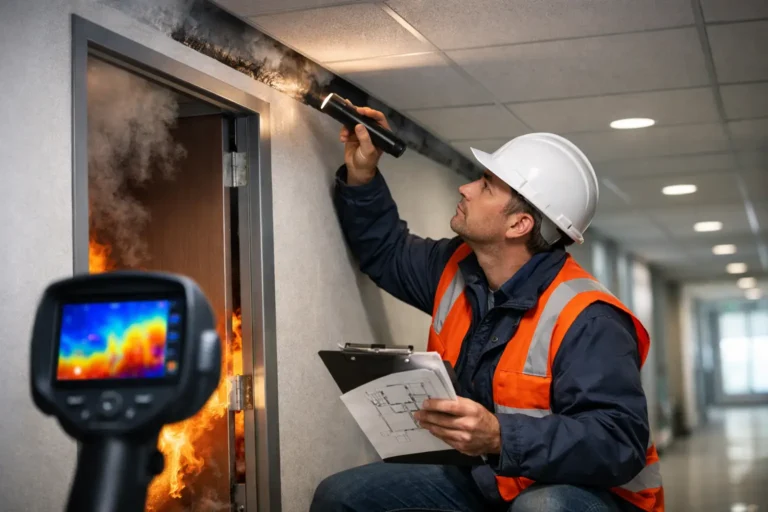
Specialist fire stopping inspections examine the condition, continuity and suitability of protection at these vulnerable points. The inspection should be systematic rather than selective guesswork, with findings recorded by location and supported by photographs where appropriate. This creates an auditable record of what was inspected, what was found and what action is required.
The most common problems are not always dramatic. They are often the result of ordinary building activity carried out without passive fire protection being reinstated. Typical failures include:
- open or partially sealed penetrations around cable trays, pipes and conduits;
- damaged fire batt, mastic or mortar following later works;
- combustible materials passing through a compartment line without suitable protection;
- incorrect or unproven products used around particular services; and
- fire doors, walls or floors compromised by services installed after the original build.
Each issue needs to be judged in context. A small gap in a low-risk area may require a different response from multiple unsealed openings in a busy care home escape route or a residential riser serving several floors. That is why a report should prioritise risk, not merely generate a long defect list.
The duty holder’s exposure is wider than a failed inspection
Where fire stopping is inadequate, the immediate concern is life safety. Compartmentation is intended to slow the spread of fire and smoke, protecting escape routes and buying time for evacuation and firefighting. When penetrations are left open, that strategy can fail far sooner than the building’s fire safety arrangements assume.
There are operational consequences too. Defects can affect fire risk assessment findings, planned works, insurance discussions, resident confidence and the outcome of external audits. For responsible persons and other duty holders, uncertainty is itself a risk. If you cannot show what has been checked, what defects were identified and how they were resolved, it is difficult to demonstrate effective control.
The legal duties will depend on the premises, occupation and applicable fire safety regime. However, the central expectation remains clear: fire precautions must be maintained, suitable measures must be taken where deficiencies are identified, and records must support the decisions made. Waiting for enforcement action or a failed assessment is an expensive way to discover a hidden problem.
What a useful inspection process looks like
A good inspection begins with scope. The inspector needs to understand the building type, use, occupancy, known compartment lines, recent works and areas of concern. A school, hospital, warehouse and block of flats do not present the same access challenges or risk profile, so the survey approach should reflect the site.
Access planning matters. The most important defects may be concealed, which can mean arranging access to ceiling voids, risers, locked rooms or tenant areas. Some locations may require intrusive opening-up to confirm the condition of concealed fire stopping. This should be proportionate and agreed in advance. Non-intrusive checks are less disruptive, but they cannot verify what cannot be seen.
During the inspection, each penetration or area should be assessed against the compartment line and the services passing through it. The aim is to establish whether a suitable tested or assessed system appears to be present, whether it remains intact, and whether later alterations have compromised it. Clear location references are essential. “Defect in corridor” is not enough when a maintenance team needs to find and rectify the issue quickly.
The final report should separate urgent life-safety concerns from planned remedial works. It should explain the issue in plain English, identify the location, include photographic evidence where possible and set out a practical recommendation. The best reports help managers make decisions. They do not leave them with technical jargon and no route to compliance.
Inspection alone does not close the compliance gap
A survey can identify the problem, but it does not repair it. This is where many duty holders lose time: one company inspects, another interprets the report, a third carries out works, and nobody takes ownership of the final evidence. Delays increase exposure, particularly where defects affect escape routes, sleeping accommodation or high-occupancy areas.
An end-to-end approach reduces that uncertainty. Following inspection, remedial works should be specified and completed using suitable systems for the particular application. Installers need to understand product compatibility and manufacturer requirements, rather than treating every opening with the same sealant or board. Works should then be checked, recorded and certified so the duty holder has a coherent compliance trail.
There is a balance to strike. Not every defect requires disruptive major works, and not every area can be opened up immediately in an occupied building. A competent provider will help you prioritise urgent failures, plan access around residents, pupils, patients or business operations, and phase lower-risk remediation without losing control of the wider programme.
When should you arrange fire stopping inspections?
There is no single timetable that suits every building. Frequency should be informed by the fire risk assessment, building complexity, occupancy, maintenance activity, refurbishments and history of defects. High-change environments and buildings with numerous concealed services generally need closer attention than simple, stable premises.
Inspections are particularly valuable after refurbishment, electrical or mechanical upgrades, data cabling projects, compartment wall alterations, water leaks, damage repairs or changes to building use. They should also be considered when a fire risk assessment identifies concerns about compartmentation, when documentation is incomplete, or before an external audit, acquisition or major handover.
Do not assume recently completed work is compliant because it is new. Fire stopping can be missed at the interface between trades, especially where programmes are tight and responsibility is unclear. Early inspection is usually faster and less costly than returning after ceilings have been closed and occupants have moved back in.
Give your evidence the same attention as the repair
A completed repair without traceable evidence can create another problem later. Building managers change, paper files disappear and maintenance teams need to know what system is present before working nearby. Good records protect both the building and the people responsible for it.
Keep inspection reports, defect schedules, photographs, product information, installation details, certificates and records of follow-up action together. Make sure locations are understandable to the next person who needs to inspect or maintain the area. If a defect is accepted temporarily because access is restricted, record the reason, interim controls and agreed completion date.
FireBlocked365 helps duty holders move from hidden defects to clear remedial action and documented sign-off, without making a critical compliance task harder than it needs to be. The priority is not simply finding faults. It is restoring control over the safety of the building.
If your premises have been altered, your records are unclear or your fire risk assessment has raised compartmentation concerns, act before uncertainty becomes exposure. A properly planned inspection can give you the facts, the priorities and the evidence needed to protect the people who rely on your building every day.