A failed fire assessment rarely comes down to one dramatic fault. More often, it is the accumulation of small, visible gaps: a fire door that does not self-close, unsealed service penetrations above a ceiling, missing inspection records, unclear responsibilities and remedial actions that were never closed out. First time fire assessment success comes from treating those gaps as urgent operational risks before an assessor, insurer, auditor or enforcing authority finds them.
For landlords, managing agents, schools, care homes, hospitals and commercial building managers, the pressure is real. A poor outcome can expose occupants to danger, disrupt operations, damage confidence and create difficult questions from boards, residents, regulators and insurers. The answer is not a rushed tidy-up the week before an inspection. It is a controlled process that identifies defects, puts them right and proves the work has been completed properly.
What a successful fire assessment actually looks like
There is no single universal “pass” certificate for every type of premises or fire safety assessment. The standard of scrutiny depends on the building, its use, its occupants and the scope of the review. A care home with vulnerable residents, for example, requires a different level of control from a small low-risk office. Multi-occupied residential buildings can also carry additional duties and inspection requirements.
But the principles behind a good outcome are consistent. A competent assessor should be able to see that fire risks have been identified, appropriate precautions are in place, defects are recorded clearly and priority actions are being managed to completion. The evidence must match the building as it stands, not how the building was when a report was first issued.
A successful assessment is therefore not about hiding defects. It is about demonstrating responsible control: you know what needs attention, you understand the risk, the right people are acting, and there is a documented route to completion.
Start with the failures that cause most concern
A pre-assessment review should focus first on issues that could compromise containment, escape or warning. These are the defects most likely to turn an otherwise organised site into a serious compliance concern.
Fire doors must perform, not just look presentable
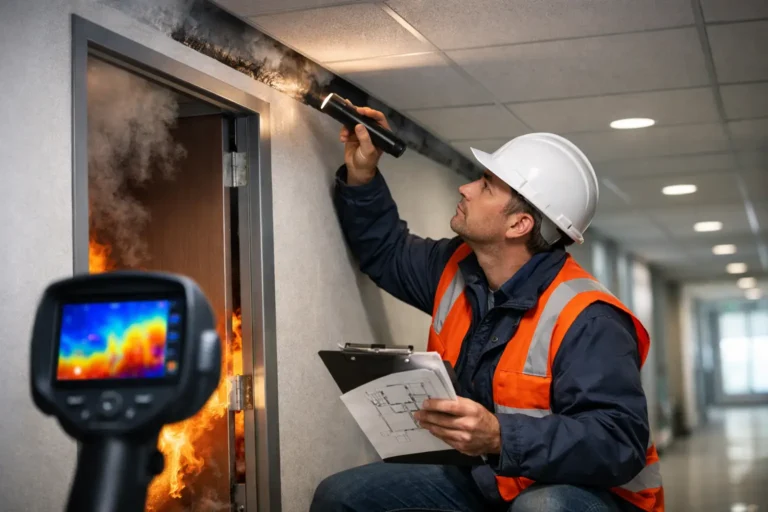
A fire door is a life-safety component, not ordinary joinery. It must be suitable for its location, fit correctly within the frame and close fully against the latch where required. Common failures include excessive gaps, damaged leaves, missing or unsuitable seals, defective hinges, unsuitable glazing, holes or unapproved alterations, and closers that are disconnected or too weak to shut the door.
Do not assume a door is compliant because it carries a label, looks heavy or has been painted red. Its condition, installation and ability to close are what matter. Door sets in escape routes, riser cupboards, plant rooms and compartment walls deserve particular attention because a failure can allow smoke and fire to spread beyond the area of origin.
Fire stopping is often hidden, but never optional
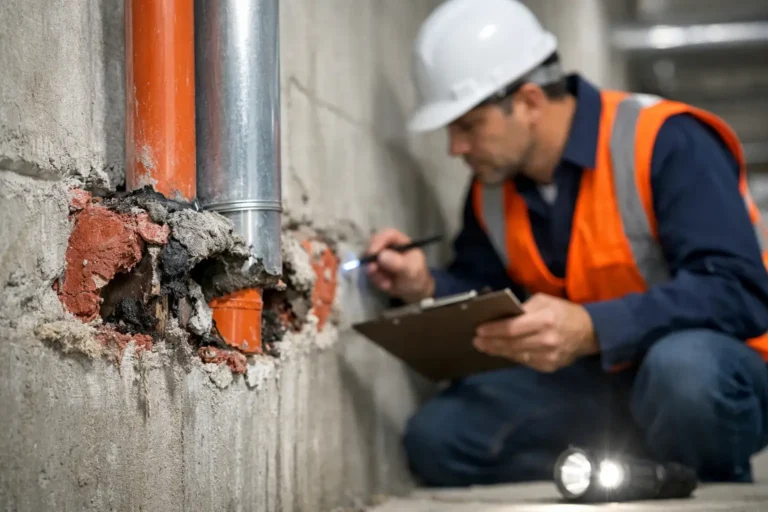
Contractors, IT installers and maintenance teams regularly create new openings through compartment walls and floors. A cable tray, pipe, duct or bundle of services may appear minor, yet an unsealed penetration can defeat the fire-resisting construction around it.
Inspect risers, ceiling voids, service cupboards, plant spaces and recently altered areas. Look for gaps around services, damaged seals, missing collars, inappropriate foam and installations with no supporting evidence of the system used. The remedial work must be appropriate to the substrate, service type and required fire resistance. A quick fill around a pipe is not automatically a compliant fire-stopping solution.
Escape routes need to work under pressure
Walk every escape route as though the building has lost power and occupants are moving quickly. Check that corridors, stairways and final exits are clear, exit doors open readily in the direction needed, emergency lighting is tested and visible, signs are appropriate, and fire action notices are current and relevant.
Storage in corridors is a recurring problem, especially in schools, flats, care settings and busy commercial buildings. Even where an item seems harmless, it can restrict movement, add combustible material or create smoke hazards. Clear ownership is essential: if no one is responsible for keeping routes clear, the problem will return the day after the inspection.
Build evidence before someone asks for it
Many duty holders have carried out sensible work but cannot demonstrate it quickly. Records are split across inboxes, old contractor reports, maintenance folders and the memory of a former manager. That creates uncertainty precisely when you need confidence.
Bring key documents into one accessible compliance file. Your evidence should show the current fire risk assessment and action plan, fire door inspection records, fire alarm and emergency lighting test records, evacuation arrangements, staff training where relevant, maintenance certificates and clear evidence that remedial actions have been completed.
Photographs are useful when they are dated, labelled and linked to a specific location or action reference. Before-and-after images can support a remedial record, but they should not replace competent inspection or certification where that is required. Equally, a contractor invoice alone does not prove that the correct material, system or installation method was used.
For larger or higher-risk sites, a live action tracker makes the process far easier to manage. It should identify the defect, location, risk priority, responsible person, target date, current status and completion evidence. This creates accountability and prevents high-priority items disappearing into a vague list of “works outstanding”.
Turn findings into completed remedial work
The weakest point in many compliance programmes is the handover between survey and repair. A report identifies faults, but the building manager must then source contractors, explain the scope, manage access, control disruption and check that the work has actually resolved the issue. Delays are common, especially where residents, pupils, patients or operational teams need access to affected areas.
This is where scope matters. A vague instruction such as “repair fire doors” invites inconsistent work and makes quality control difficult. Each action should state what is wrong, where it is, the required outcome and how completion will be verified. If a door needs new intumescent seals, for example, the record should identify the door, the specification and the post-work check required.
Urgency should be driven by risk, not convenience. Defects affecting means of escape, compartmentation, automatic fire detection or vulnerable occupants may need immediate interim controls while permanent repairs are arranged. Depending on the risk, that could mean removing combustibles, increasing checks, restricting use of an area or implementing a managed fire watch. Interim measures must be realistic, documented and actively monitored. They are not a substitute for permanent corrective work.
A specialist end-to-end provider such as FireBlocked365 can reduce this handover risk by surveying defects, completing suitable remedial work and providing clear documented sign-off. The advantage is not simply speed. It is continuity: the people fixing the issue understand why it was raised and what evidence is needed to close it properly.
Prepare the people who run the building
Fire safety compliance is not secured by a folder in a locked cabinet. The people on site must understand the basic controls that keep the building safe between inspections. Reception teams need to know how to keep escape routes clear. Facilities teams need to recognise that drilling through a compartment wall creates a fire-stopping requirement. Staff need to know what to do if a fire door is wedged open or a final exit is obstructed.
Keep the message practical. Ask who checks the common areas, who logs faults, who has authority to arrange urgent repairs and who reviews overdue actions. In managed residential buildings, the answer may involve the Responsible Person, managing agent, maintenance contractor and residents. In schools or care homes, it may involve leaders, estates teams, shift managers and nominated fire marshals.
Where responsibilities are unclear, write them down. A simple ownership structure is more valuable than a long policy nobody follows.
Avoid the last-minute mistakes
The days before an assessment are for confirmation, not panic. Walk the premises with the action tracker and check that high-priority repairs are genuinely complete. Test the practical basics: doors close, exits open, routes are clear and key records can be produced without a search through multiple systems.
Do not conceal faults, backdate tests or present unfinished work as complete. Assessors can usually see where evidence does not align with conditions on site, and the resulting loss of trust can be more damaging than an openly managed outstanding item. If a repair cannot be completed in time, document the risk, explain the interim control, assign a completion date and ensure the decision has been made by the appropriate responsible person.
For premises in England and Wales, the Regulatory Reform (Fire Safety) Order 2005 places duties on the Responsible Person. Requirements and enforcement arrangements can differ elsewhere in Great Britain, so site-specific professional advice remains essential. The point is not to chase paperwork for its own sake. It is to show that fire risks are being managed with the seriousness they demand.
Before your next assessment, choose one area that has been difficult to control – perhaps fire doors, service risers or overdue actions – and inspect it properly. One verified improvement, recorded and owned, is safer than ten untested assurances.