A fire door that will not latch, an unsealed service penetration, or a poorly recorded alarm test can turn a routine inspection into a serious compliance failure. The question of when is fire safety certification needed matters because duty holders are often asked for proof at the exact moment they cannot afford uncertainty: after a fire risk assessment, during an insurer review, before handover, or following an enforcement visit.
The crucial point is this: there is no single certificate that proves an entire building is fire-safe forever. Certification and documented sign-off are needed at specific stages, for specific systems and works. Your wider legal duty is ongoing – to assess risk, maintain protective measures and keep people safe.
For landlords, managing agents, schools, care providers, housing associations and commercial building managers, the safest approach is to treat certification as evidence of control. It shows what was inspected, what was found, what was repaired and who confirmed the work meets the required standard.
When is fire safety certification needed?
Fire safety certification is commonly needed when new fire safety measures are installed, when remedial work is completed, when a building is altered, or when inspection findings identify defects that must be corrected. It may also be requested by building control, a responsible person, an insurer, a client, a regulator or a prospective purchaser.
Under the Regulatory Reform (Fire Safety) Order 2005 in England and Wales, the responsible person must take general fire precautions and ensure relevant equipment, devices and facilities are subject to a suitable system of maintenance. The Order does not issue every premises with one universal annual fire certificate. However, records, test results, competence evidence and certificates for particular works are often essential to demonstrate that your duties have been met.
In practical terms, you need reliable evidence whenever someone needs to verify that a fire protection measure performs as intended. A verbal assurance from a contractor is not enough when occupants, enforcement authorities and your organisation’s reputation are at risk.
Scotland has its own fire safety legislation and enforcement framework. If you operate across GB, make sure your compliance process reflects the rules for the nation in which each building sits rather than applying a one-size-fits-all checklist.
Certification is not the same as a fire risk assessment
A fire risk assessment identifies hazards, people at risk and the precautions needed to keep the premises safe. It is the starting point for deciding whether a fire door survey, fire stopping inspection, alarm upgrade or other remedial action is required.
Certification, by contrast, is evidence connected to a product, installation, inspection, test or completed repair. It may confirm, for example, that a fire alarm system has been commissioned, emergency lighting has been tested, fire stopping works have been installed correctly, or a fire door has been assessed and remediated.
Both matter. An up-to-date risk assessment without proof that its priority actions were completed leaves a gap. Equally, a folder of certificates cannot compensate for an out-of-date assessment that no longer reflects the way the building is occupied, altered or managed.
Situations that usually require documented sign-off
After fire door repairs or replacement
Fire doors are life-safety equipment, not ordinary joinery. A door may look acceptable while failing because the gaps are excessive, seals are missing, hinges are unsuitable, glazing is damaged or the closer does not shut the leaf fully into the frame.
Where defects are repaired, replaced or adjusted, keep clear evidence of the scope, materials used, competency of the installer and final inspection. For new or replacement fire doors, certification and installation records are particularly important. They help demonstrate that the door set was fitted in a way that preserves its tested performance, rather than compromising it at the final stage.
This is especially relevant in blocks of flats, care homes, schools, hospitals and multi-occupied commercial premises, where door failures can affect escape routes and compartmentation across an entire building.
Following fire stopping work
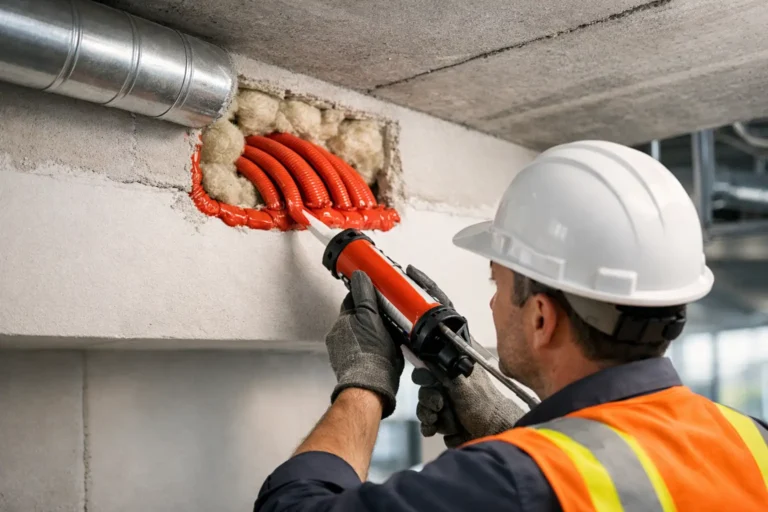
Fire stopping seals the openings created where pipes, cables, ducts and structural elements pass through walls and floors. These hidden gaps are among the most common and dangerous compliance failures. If smoke and fire can travel through a service penetration, the compartment line has been breached.
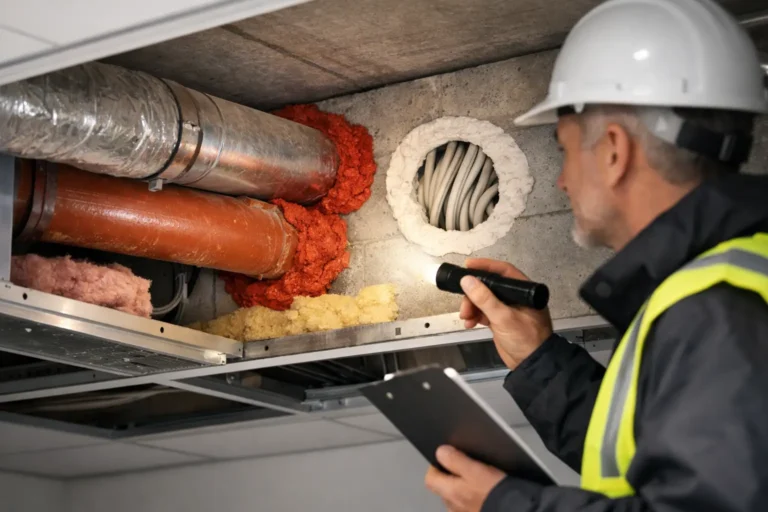
Certification is needed after remedial fire stopping works so there is a traceable record of what was sealed, where it was located, which system was used and how the completed work was checked. Photographic records are often valuable because much of the work will later be concealed by ceilings, boxing or finishes.
Do not accept generic paperwork that says a site is compliant without tying the evidence to locations and specific defects. Good certification should make it possible to understand what was done months or years later, even when the original contractor is no longer on site.
When systems are installed, altered or commissioned
A new fire alarm system, emergency lighting installation or other active fire safety system needs appropriate commissioning, testing and handover documentation. If a system has been materially altered, expanded or repaired, the level of certification required depends on the work completed and the relevant standard.
This is where shortcuts cause real exposure. A building may have alarm devices on the ceiling, but if there is no commissioning evidence, logbook history or confirmation that the system operates correctly, you may struggle to prove it was suitable and maintained. The same principle applies to emergency lighting, smoke control equipment and, where relevant, extinguishers.
Your records should identify the system, date, competent person or provider, defects found, actions taken and any limitations. A certificate with no supporting detail can create false confidence rather than assurance.
After building work or a change of use
Refurbishment, layout changes and new services can affect escape routes, compartment walls, fire doors and alarm coverage. Building work may also trigger Building Regulations requirements, with building control sign-off or completion documentation needed before the works are treated as complete.
A change of use can be just as significant. Converting offices into sleeping accommodation, increasing occupancy, creating shared areas or changing a warehouse operation can alter the fire risk overnight. Review the fire risk assessment before the new use begins, then obtain the necessary inspection records and certification for any measures installed or upgraded.
The trade-off is simple: addressing these questions early may add time to a project programme, but discovering missing fire stopping or non-compliant doors at practical completion is far more disruptive and costly.
What duty holders should keep on file
The right records depend on the premises and its risks, but your compliance file should tell a clear story from assessment to close-out. Keep the current fire risk assessment, action plan, inspection reports, test logs, maintenance records, certificates, photographs of concealed remedial work and evidence that defects have been closed.
For higher-risk residential buildings, record keeping and information management duties can be more demanding. Even where a formal certificate is not expressly required, a well-organised evidence trail protects the accountable people responsible for the building and supports effective handover between managing agents, contractors and owners.
Make sure documents are current, legible and easy to retrieve. A certificate buried in an old inbox does not help during an emergency, audit or enforcement inspection.
How to avoid certification that does not stand up to scrutiny
The quality of the inspection and the competency behind the paperwork matter as much as the certificate itself. Low-cost, surface-level checks can miss concealed fire stopping defects, unsuitable door hardware or recurring maintenance failures. They may also leave you with vague recommendations that no one owns or completes.
Start with a competent survey that identifies the actual condition of the building. Then ensure remedial works are properly scoped, completed by suitable specialists and checked before sign-off. Ask for reports that clearly distinguish between observations, urgent defects, completed work and residual actions.
This end-to-end approach prevents a common failure: paying for an inspection, receiving a list of problems, and still having no documented proof that the risks were controlled. FireBlocked365 helps duty holders move from detailed assessment through remedial work to clear certification, reducing disruption while building an evidence trail that can withstand scrutiny.
Act before an inspection forces the issue
Do not wait for a failed audit, resident complaint, insurer query or enforcement notice to discover whether your records are enough. If your premises have recently been altered, if fire doors have been repaired, if penetrations have been sealed, or if your documentation is incomplete, arrange a specialist review now.
The most useful certificate is not the one produced under pressure. It is the clear, credible sign-off that lets you show occupants, regulators and your own organisation that fire safety has been actively managed – and that the building is safer because of it.