A building can look compliant on the surface and still fail where it matters most – inside risers, above ceilings, behind service penetrations and around poorly altered walls. That is exactly why a fire stopping survey matters. For duty holders, it is not a paperwork exercise. It is a direct check on whether fire and smoke could spread through the very gaps that should have been sealed.
If you are responsible for a school, care home, block of flats, hospital or commercial premises, the pressure is real. You are answerable to residents, staff, regulators, insurers and senior stakeholders. If compartmentation has been breached and nobody has found it, the risk is not theoretical. It affects life safety, legal exposure and whether your building will stand up to scrutiny when an assessment takes place.
What is a fire stopping survey?
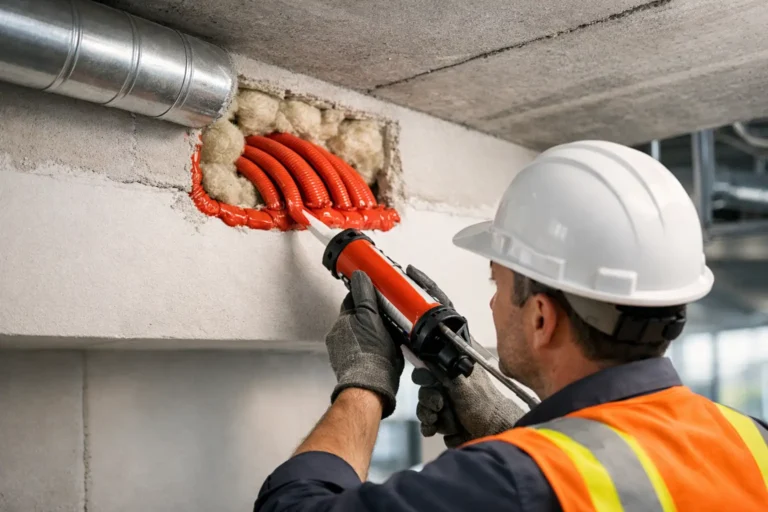
A fire stopping survey is a detailed inspection of the measures used to maintain fire compartmentation in a building. In practical terms, it checks whether openings around pipes, cables, ducts, trays and structural junctions have been correctly sealed with suitable fire-stopping systems.
The aim is simple. If a wall or floor is designed to resist fire for a set period, any hole cut through it for building services must be protected to the same standard. Once that protection is missing, damaged, unsuitable or badly installed, the compartment is compromised.
That is where many buildings fail. Not because nobody intended to comply, but because works have taken place over time. Electricians add cabling. Plumbers replace pipework. Contractors alter layouts. Ceiling voids are disturbed. A compliant barrier becomes a weak point one small opening at a time.
Why fire stopping failures are often missed
Most fire-stopping defects are not obvious during day-to-day building management. They sit in concealed spaces, locked cupboards, service risers and plant areas where only a specialist inspection will identify them properly.
There is also a reporting problem. Generic inspections may note compartmentation concerns without tracing the full extent, identifying the correct remedial method or giving you evidence that will satisfy auditors and enforcement bodies. That leaves duty holders with half the picture – enough to cause concern, not enough to resolve it.
A proper fire stopping survey goes further. It does not stop at spotting a gap. It records the location, the type of breach, the likely impact on fire resistance and what needs to happen next. That distinction matters when you need clear action, not vague warnings.
What a fire stopping survey should cover
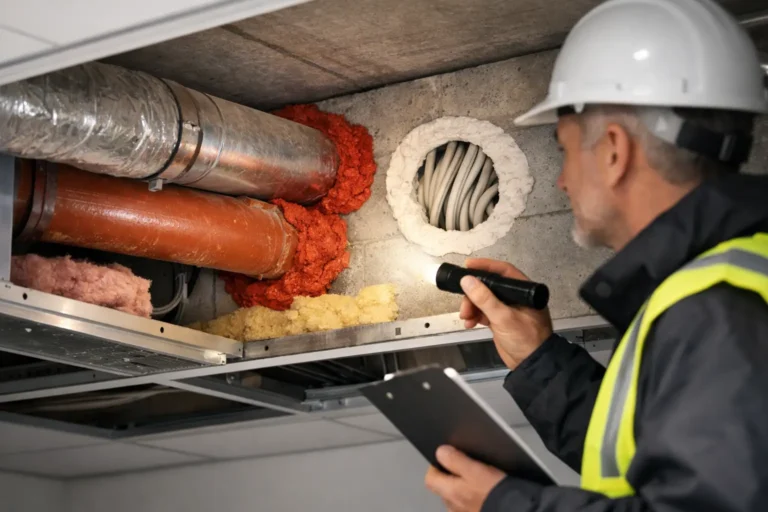
A reliable survey should assess the areas where fire and smoke are most likely to travel if compartmentation has failed. That usually includes service penetrations through walls and floors, ceiling void interfaces, risers, plant rooms, roof spaces, vertical and horizontal compartments, and areas affected by refurbishment or repeated maintenance.
The quality of the inspection matters as much as the checklist. Some sites need sample-based inspection because access is limited or the estate is extensive. Others need a more intrusive approach because the building use is high risk or previous records are poor. There is no value in pretending every building can be treated the same.
A useful report should tell you what is compliant, what is not, and which defects carry the greatest urgency. It should also make clear whether the issue is isolated or systemic. If one riser has repeated poor sealing, for example, there is a fair chance the problem is wider than a single location.
Common issues found during fire stopping surveys
The same failures appear again and again across occupied buildings. Mixed services pushed through one oversized opening. Foam used where a tested system is required. Broken seals after later contractor works. Unsealed cable bundles. Plastic pipe penetrations with no suitable fire collar. Damaged boarding around service risers. Gaps left around trunking, conduits or ductwork.
Older buildings can be especially challenging because records are limited and historic alterations may not reflect current standards. Newer buildings are not automatically safer. Fast programmes, poor oversight and fragmented subcontracting can leave hidden defects behind from day one.
This is why assumptions are dangerous. A recent refurbishment does not prove compartmentation is sound. Neither does a clean-looking corridor or a passed maintenance visit.
Why duty holders should act before an audit forces the issue
Waiting until a fire risk assessment, insurer query or enforcement concern highlights compartmentation issues usually means higher cost, greater disruption and more pressure. Once defects become a live compliance issue, decisions need to be made quickly and often under uncomfortable scrutiny.
A fire stopping survey carried out early gives you control. You can prioritise the highest-risk areas, budget sensibly, programme works around occupancy and avoid the panic that follows a failed inspection. More importantly, you reduce the risk to people in the building now, not after a formal challenge arrives.
For schools and care settings, that matters because evacuation may be slower or more complex. In residential blocks, it matters because compartmentation is central to containing fire within the flat of origin. In hospitals and supported accommodation, the consequences of smoke spread can be severe long before flames become the main issue.
What good reporting looks like
Not all survey reports help in the way they should. Some are too technical to support quick decisions. Others are too vague to justify remedial work or demonstrate a clear audit trail.
Good reporting should be visual, specific and prioritised. It should identify the defect location clearly, explain the non-compliance in plain English, support findings with photographic evidence and set out remedial recommendations that can actually be delivered. If there are limitations to access, those should be recorded honestly rather than glossed over.
For duty holders, this is where reassurance comes from. You need to know what the problem is, how serious it is, and what must happen to close it out properly. Anything less leaves risk sitting on your desk.
Survey only or survey through to sign-off?
This is one of the biggest practical decisions. A stand-alone survey can be useful if you already have trusted contractors and internal compliance oversight. But many clients are left chasing multiple parties, translating technical findings and trying to prove that repairs were completed to the right standard.
An end-to-end approach is often stronger. The same specialist team identifies defects, scopes remedials, completes the work and provides the documentation needed for sign-off. That reduces delay, avoids misinterpretation and gives you a cleaner line of accountability.
It also means defects are less likely to be downgraded, missed in handover or patched with unsuitable materials. When compliance is under pressure, continuity matters.
When should you arrange a fire stopping survey?
The short answer is before you are forced to. In reality, certain triggers make a survey particularly urgent. Refurbishment works are a major one, especially where multiple service trades have passed through compartment lines. A poor or outdated fire risk assessment is another. So are insurer concerns, acquisition due diligence, changes in building use, or a lack of reliable compartmentation records.
If your site has never had a focused fire stopping survey, that alone is reason enough to act. Many responsible managers assume this has been checked as part of general compliance. Often it has not.
There is also a practical timing point. Surveys are easier to manage before defects multiply and before occupancy patterns make access harder. Early intervention nearly always gives you more options.
Choosing a provider that will stand up to scrutiny
This is not a job for a generalist with a camera and a template. You need specialists who understand how fire-stopping systems are meant to perform, where installations commonly fail, and how findings translate into remedial action and certifiable outcomes.
Look for technical competence, clear reporting, responsive communication and a process that does not leave you carrying the problem alone. Speed matters, but only if accuracy comes with it. A rushed inspection with weak evidence can create as much trouble as no inspection at all.
That is why many duty holders choose a specialist partner such as FireBlocked365 – not just to identify breaches, but to take control of the compliance process from survey through to corrective works and documented completion.
The real value of a fire stopping survey is not the report itself. It is the certainty that hidden failures have been exposed before they become a serious incident, a failed audit or a question you cannot answer. If you are responsible for people, premises and compliance, that certainty is worth securing sooner rather than later.