A fire door does not get a second chance. If it fails during an inspection, you face delays, remedial costs and awkward questions. If it fails in a real fire, the consequences are far worse. That is why commercial fire door repairs are not a maintenance afterthought. They are a core part of building compliance, life safety and operational control.
For landlords, estates teams, school leaders, care providers and commercial building managers, the pressure is real. You are expected to keep occupants safe, satisfy insurers, meet legal duties and produce evidence that your building is being managed properly. A damaged or poorly performing fire door can undermine all of that quickly, especially when the defect was visible and left unresolved.
Why commercial fire door repairs matter more than most teams realise
Fire doors are there to hold back smoke and fire long enough for people to escape and for compartmentation to do its job. When a door leaf is damaged, the gaps are wrong, the seals are missing or the closer is not working properly, that protection is compromised. The problem is not always dramatic. In many buildings, the failure starts with small defects that staff have got used to seeing every day.
A door that slams, sticks, drags on the floor or has been wedged open can feel like a nuisance issue. In compliance terms, it is much more serious. One faulty fire door can affect means of escape, compartmentation strategy and the outcome of a wider fire risk assessment. It can also signal poor fire safety management across the site, which tends to attract more scrutiny rather than less.
This is where many duty holders get caught out. They assume replacement is the only answer, delay action because of cost, or pass the issue to a general contractor who fixes the obvious damage but misses the compliance detail. Fire doors are specialist life safety assets. Repairs need to restore performance, not just appearance.
What actually counts as a fire door defect?
Some defects are easy to spot. Others are less obvious but still enough to cause failure. Common examples include damaged door leaves, broken or missing intumescent and smoke seals, non-compliant glazing, poorly fitted ironmongery, loose hinges, excessive gaps around the frame and self-closing devices that no longer shut the door fully into the latch.
Alterations are another frequent issue. Letter plates, air transfer grilles, kick plates, vision panels and access control hardware are often added over time without checking whether the fire door set can still perform as intended. The same applies when doors have been planed, overpainted or patched after years of wear. What looks like a practical building fix can create a serious compliance failure.
There is also the question of tolerances. A door may still open and close, but that does not mean it is fit for purpose. Small gap issues, poor alignment or incompatible hardware can be enough to compromise smoke control and fire resistance. That is why a basic handyman approach is risky. Fire door work needs the right assessment before any repair is specified.
Commercial fire door repairs or full replacement?
This is where a lot of budgets are won or lost. Not every defective fire door needs replacing. In many cases, targeted commercial fire door repairs can restore compliant performance faster and at lower cost, provided the door is suitable for repair and the work is properly assessed, completed and documented.
Repair is often appropriate where the frame remains sound, the damage is localised and the correct compatible components can be installed. Replacing seals, closers, hinges or signage may be straightforward. Adjusting alignment, correcting gaps or carrying out approved surface repairs can also be viable. The key point is that the repair must support the fire door’s intended rating and function.
Replacement becomes the safer route when there is extensive damage, unclear specification, unsuitable previous alterations or too many defects across the leaf, frame and hardware. It also makes sense when repeated patchwork repairs would leave you spending more without gaining certainty. The right answer depends on the condition of the existing door set, the evidence available and the risk profile of the building.
That is why a specialist assessment matters. You need someone who can tell you, with confidence, whether repair is defensible or whether replacement is the only option that will stand up to scrutiny.
What good fire door remedial work looks like
Good remedial work starts with a clear survey, not guesswork. Each door should be checked against relevant performance and installation criteria, with defects recorded in plain language and prioritised by risk. The goal is not to overwhelm you with jargon. It is to give you a workable plan that shows what needs attention now, what can be scheduled and what evidence you need to retain.
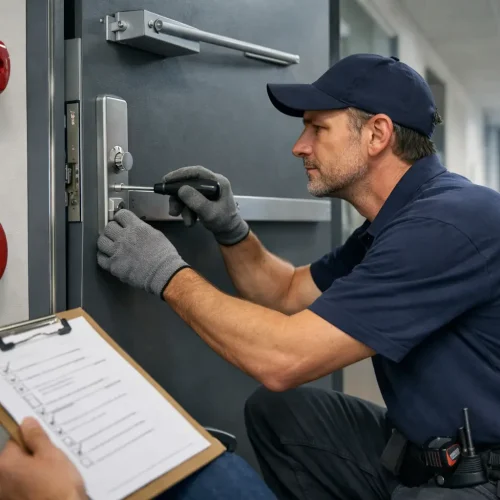
Repairs then need to be carried out by competent specialists using suitable components and methods. That means more than making the door look tidy. It means checking compatibility, preserving certification routes where relevant and making sure the finished door closes, latches and performs as intended.
Documentation matters just as much as the physical work. If you are challenged by a regulator, insurer or responsible person higher up the chain, you need more than a verbal assurance that the doors were sorted. You need a record of what was found, what was repaired, what was replaced and what standard the work was completed against. That evidence reduces uncertainty and helps you show control.
The risks of delaying commercial fire door repairs
Delay is often driven by competing priorities. A leaking roof, staffing issues or a pending inspection can push fire door defects down the list. The problem is that the risk does not wait. If a door is already failing to close or has visible damage to critical elements, every day without action leaves the building exposed.
There is also a wider cost to postponement. Small repairs are usually easier to manage than major remedial programmes. Once defects spread across multiple doors, or a poor inspection result triggers urgent enforcement, costs rise fast. Access becomes harder to coordinate, residents or staff lose confidence and internal reporting pressure increases.
In occupied settings such as schools, hospitals, care homes and multi-let buildings, delay carries another practical issue – disruption. Planned repairs can be phased sensibly. Emergency works rarely can. Acting early usually gives you more control over budget, programme and occupant impact.
How to manage the process without it taking over your job
Most duty holders do not need another technical burden. They need clarity, speed and a process they can defend. The most effective route is to treat fire door repairs as part of an end-to-end compliance plan rather than a one-off maintenance task.
That starts with identifying the doors that matter most, particularly on escape routes, risers, plant areas and compartment lines. Then you need a competent inspection, a prioritised schedule of repairs and a team that can complete the work with minimal disruption. Just as important, you need reporting that is clear enough for senior management, governors, trustees, board members or auditors to understand.
This is where specialist providers earn their place. A business like FireBlocked365 is there to take pressure off your team, not add to it – by finding hidden failures, carrying out remedial work properly and giving you the documentation needed to move forward with confidence.
Choosing a contractor for commercial fire door repairs
Price matters, but on fire doors it cannot be the only filter. If the contractor does not understand certification routes, allowable repairs, component compatibility and inspection standards, a cheap fix can become an expensive repeat visit. Worse, it can leave you believing the risk has been dealt with when it has not.
Look for clear competence, practical experience in regulated buildings and a reporting process that supports compliance, not just invoicing. You also need responsiveness. If you have identified high-risk defects, waiting weeks for action is not good enough. The right contractor will be direct about what can be repaired, what cannot and how quickly the building can be brought back under control.
A good partner should also understand your operating environment. A school has different access constraints from a care home. A hospital has different risk tolerances from an office block. The work needs to fit the building, the occupants and the urgency of the issue.
When fire door defects appear, the real question is not whether you can afford to act. It is whether you can afford the consequences of leaving a known failure in place. The safest position is always the same: identify the risk clearly, repair it properly and keep hold of the evidence that proves you did the right thing.