One failed fire door, one missing alarm test, one blocked escape route – that is often all it takes for a routine tenancy issue to become a life-threatening incident, an insurance dispute, or a legal investigation. Landlord fire safety obligations in the UK are not a box-ticking exercise. They are a direct responsibility tied to occupied buildings, vulnerable residents, and decisions that will be examined closely if something goes wrong.
For landlords, agents and building managers, the pressure is real. The law is not always written in plain English, and responsibilities change depending on the type of property, who occupies it, and whether common parts exist. What matters is being clear on where your duty starts, what must be checked, and where specialist support is needed before a small defect turns into a serious compliance failure.
What landlord fire safety obligations in the UK actually cover
The phrase landlord fire safety obligations UK is broad because the duties themselves sit across several areas. In simple terms, landlords must take reasonable steps to reduce fire risk, provide appropriate warning systems, keep escape routes usable, and make sure fire safety features are not left to chance.
That does not mean every landlord has exactly the same obligations. A single-let house will not be managed in the same way as an HMO, a converted block, or a building with shared corridors and stairwells. The practical standard depends on the property layout, the occupants, and whether parts of the premises fall under wider fire safety legislation.
For most landlords, the legal picture usually includes smoke and carbon monoxide alarm requirements, electrical safety responsibilities, furniture and furnishings rules where relevant, and duties relating to the structure and common areas. Where a property contains common parts, or falls into a category with stronger fire precautions, the expectation rises quickly.
The difference between a single dwelling and a higher-risk building
This is where landlords often get caught out. If you let out a standard single-family home, your duties are narrower than those for a multi-occupied building. You still need working alarms, safe electrical installations, and a property that does not expose tenants to obvious fire hazards. But in a building with shared spaces, multiple occupants, or a more complex escape strategy, the level of control and inspection needs to be much stronger.
HMOs are a common pressure point. Depending on size, storeys and local authority rules, you may need fire doors, emergency lighting, fire alarm systems beyond simple domestic detectors, and a more structured fire risk assessment process. In blocks of flats, the duties around communal areas, flat entrance doors and compartmentation become especially important. Many landlords assume these features are sound because the building looks fine on the surface. That is a risky assumption.
The trade-off is simple. The more people affected by a fire, and the more complex the escape arrangements, the less room there is for guesswork.
Fire risk assessments are not optional where common parts exist
If you control a building with common areas, you are likely to have duties under fire safety law as the responsible person or duty holder. That means identifying fire hazards, assessing who is at risk, reviewing existing precautions, and acting on any findings.
A fire risk assessment should never be treated as a document to file away and forget. If the building changes, tenant profile changes, layout changes, or works affect walls, ceilings, service penetrations or doors, the assessment may need review. The same applies if previous actions were identified but never completed.
This is where many landlords fall short. They commission an assessment, but defects remain open for months. From an enforcement point of view, a known issue left unresolved can be more damaging than an issue not yet discovered. If a report identifies failed fire stopping, damaged self-closing doors, inadequate signage or compromised escape routes, those items need managing properly and quickly.
The areas that cause the most failures
In practice, the biggest problems are rarely dramatic. They are usually familiar defects that have been ignored for too long.
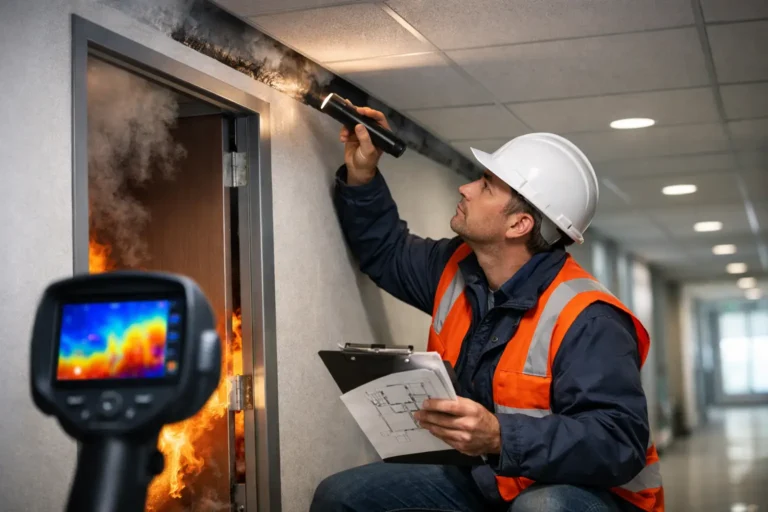
Fire doors are a major example. A fire door that does not close properly, has excessive gaps, missing seals, damaged ironmongery or unapproved alterations may fail when it matters most. In many buildings, flat entrance doors and doors protecting communal corridors are critical to containing smoke and fire. Yet they are often poorly maintained, wedged open, painted over, or replaced without the right specification.
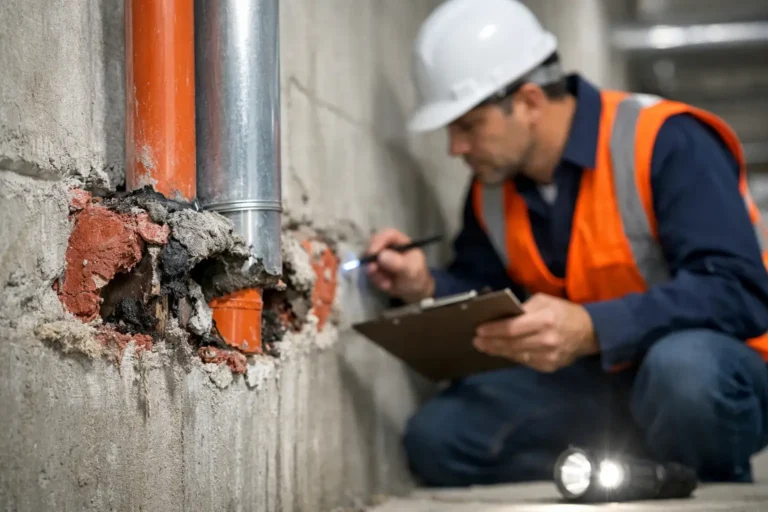
Compartmentation is another hidden risk. Holes around pipes and cables, poorly sealed service risers, and disturbed walls above ceilings can allow fire and smoke to spread far faster than intended. This is not always visible to a landlord carrying out a basic walk-through, which is why specialist inspection matters.
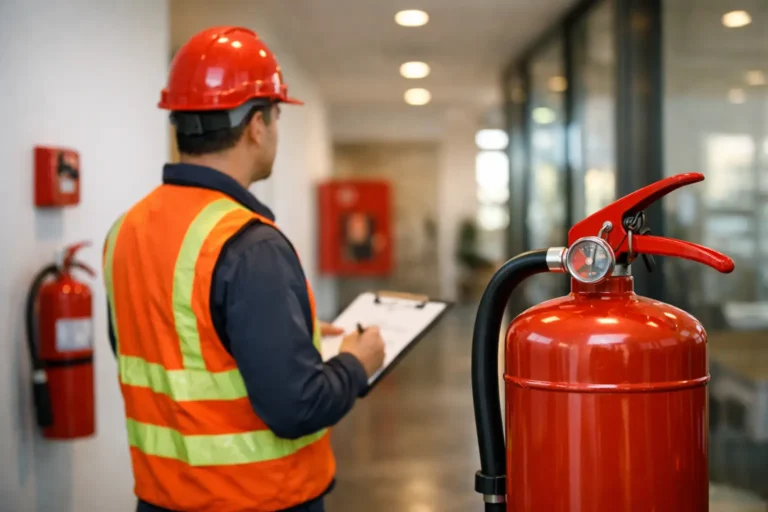
Alarm systems also cause issues, especially when there is confusion over who tests them, how often they are serviced, and whether the system is suitable for the building. A domestic detector arrangement may be acceptable in one setting and completely inadequate in another. The answer depends on the property type.
Then there are escape routes. Stored items in communal corridors, defective emergency lighting, missing signage, and final exits that are hard to open can all become serious failings. These may look minor on an ordinary day. During an evacuation, they are not minor at all.
What landlords should be doing routinely
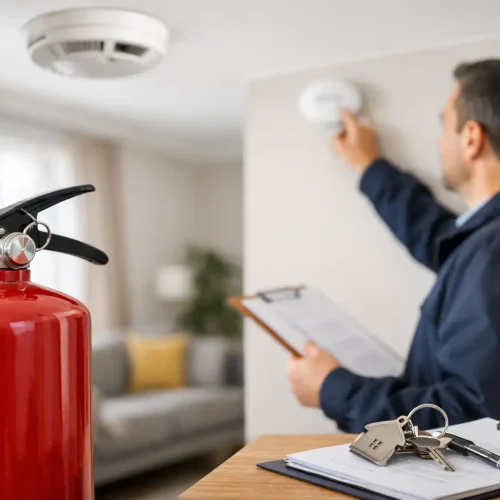
The safest approach is to treat fire safety as an active management issue, not a one-off project. Landlords should be checking that alarms are installed where required, tested at the right intervals and replaced when defective. Electrical installations should be inspected within the required timeframes, and any remedial works should be recorded and closed out properly.
Where the building has common parts, regular inspections should look for door damage, obstruction of escape routes, signage issues, and signs that compartmentation has been disturbed by contractors or maintenance works. If tenants or residents report damaged doors, missing closers or faults with emergency lighting, those reports should be treated with urgency.
Records matter too. If an enforcing authority, insurer or investigator asks what was done, when it was done, and how defects were resolved, you need more than verbal assurances. Clear documentation gives you control. It shows that risks were identified, actions were assigned, and works were completed.
Where landlords often underestimate their exposure
A common mistake is assuming that responsibility sits with tenants, managing agents, or the freeholder in a way that fully removes the landlord from risk. Sometimes duties are shared. Sometimes they overlap. Sometimes they are contractually delegated but not fully transferred in the eyes of the law.
That is why vague arrangements are dangerous. If you own, manage, or control any part of the premises, you need clarity about who is responsible for alarms, common areas, fire doors, inspections, repairs and follow-up actions. If that line is blurred, compliance can fail quietly until someone asks for evidence.
Another area landlords underestimate is speed. Once a defect is found, delay becomes its own problem. If a fire door assessment identifies widespread failures, or if fire stopping has been breached during works, waiting for a convenient moment can leave occupants exposed and your legal position weaker. Urgent response is not just good practice. In many cases, it is the difference between manageable risk and avoidable liability.
When specialist support becomes essential
Not every issue requires a full-scale survey, but some absolutely do. If you are dealing with HMOs, blocks of flats, care settings, schools, mixed-use buildings or any premises with common parts, specialist fire safety input is often the safest route. The same applies where previous works have altered doors, walls or service penetrations, or where an assessment has already flagged non-compliance.
This is where a compliance partner matters. You need more than a generic report. You need someone who can identify hidden defects, explain what actually needs doing, carry out remedial works correctly, and provide clear evidence that the problem has been closed out. That is how duty holders reduce stress, protect occupants and avoid failing formal scrutiny.
For landlords under pressure, FireBlocked365 is built around exactly that outcome – fast assessments, practical remedial action, and certification that stands up when it is tested.
Landlord fire safety obligations in the UK are really about control
The landlords who stay out of trouble are not always the ones with the newest buildings or biggest budgets. They are the ones who keep control. They know what type of property they are managing, what legal duties attach to it, what defects are present, and who is fixing them.
If your current position relies on assumptions, outdated reports, or contractors who cannot provide clear evidence, that is the warning sign. Fire safety becomes much easier to manage once it is brought into the open, inspected properly and acted on without delay.
The law may be complex, but the standard expected of landlords is not mysterious: know the risks, put the right protections in place, and do not leave known failures sitting in an occupied building. That is how you protect lives, your reputation and your position when scrutiny comes.