A failed fire door, an unsealed service penetration or damaged compartment wall is not a maintenance issue to leave in the next budget cycle. It may be the point at which smoke and fire spread beyond the area designed to contain them. Knowing how to manage fire safety remedials means turning survey findings into controlled, evidenced action that protects occupants, reduces legal exposure and stands up to scrutiny.
For landlords, responsible persons and building managers, the challenge is rarely finding a list of defects. The real challenge is deciding what must happen first, appointing people competent to carry out the work, keeping the building safe while work is underway and proving that each issue has been properly closed. A remedial programme should give you certainty, not create another folder of unanswered actions.
Start with risk, not the length of the report
A detailed fire door or fire stopping survey can identify dozens, sometimes hundreds, of defects. Treating every item as equally urgent is a mistake. A missing intumescent seal on a flat entrance door, a compromised riser wall or an open penetration around services can have a very different consequence from a minor surface defect that does not affect performance.
The starting point is to review the findings against the building’s fire risk assessment, evacuation strategy, occupancy and vulnerability of people on site. A care home, hospital, school or occupied block of flats may need faster action and more stringent temporary controls than a lightly occupied office. The remedial priority must reflect the credible risk in that specific building.
Ask your assessor or fire safety specialist to separate findings into clear categories: defects requiring immediate action, high-priority works with a defined completion date, planned remedials, and items that need further investigation before a specification can be issued. This prevents urgent safety work being buried beneath lower-risk maintenance tasks.
Where a serious defect cannot be repaired immediately, record the interim controls. This may include increasing checks, restricting use of an affected area, removing combustibles, improving management controls or arranging a temporary fire safety measure. Interim controls are not a substitute for repair. They are a documented bridge until the permanent issue is resolved.
Turn survey findings into a workable scope
A survey report identifies a problem. It does not always provide a complete installation specification. Before works begin, each remedial item needs enough detail for a competent contractor to deliver the right outcome without assumptions.
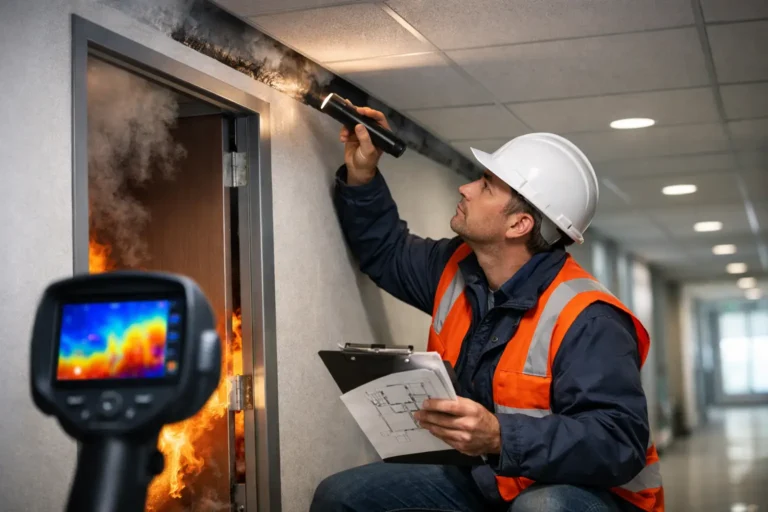
For fire doors, that means understanding the complete doorset rather than replacing one visible component in isolation. The leaf, frame, hinges, closing device, seals, glazing, ironmongery, gaps and signage all contribute to performance. Fitting a new closer to a warped leaf or an incompatible frame may not resolve the defect and can leave the door unable to perform as intended.
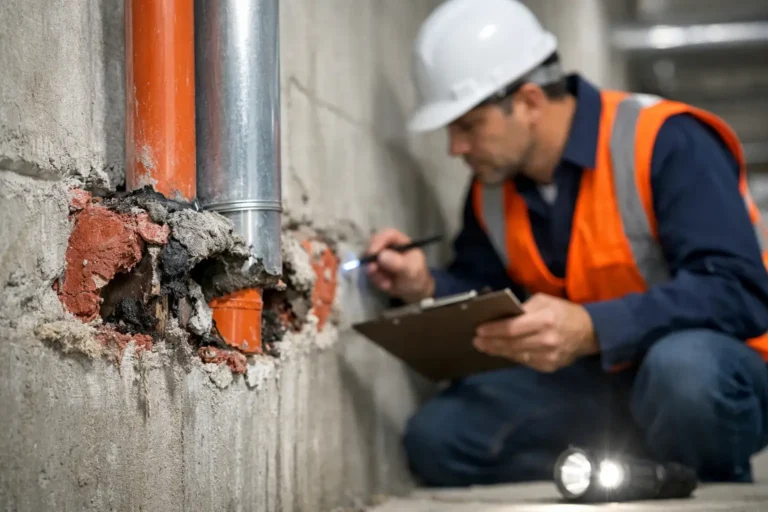
For fire stopping, the issue is equally clear. An opening around pipes, cables, ducts or structural joints should not be filled with a convenient material. The remedial solution must be suitable for the service, substrate, movement requirements and fire-resistance period required. The correct approach may involve a tested system, supporting evidence and careful installation, not simply applying mastic or foam.
A good scope also identifies access requirements, resident communication, working hours, safeguarding controls, asbestos information where relevant, reinstatement responsibilities and the evidence required at completion. This is where vague remedial recommendations become deliverable work.
Appoint competence, not the cheapest quote
Fire safety remedials are specialised works. General building experience alone does not demonstrate competence to repair or certify a fire door assembly or fire stopping system. A low initial price can quickly become expensive if work is incomplete, unsuitable products are used, records are missing or defects reappear at reassessment.
When selecting a provider, look beyond a headline quote. Establish whether they can interpret the survey, clarify the scope, supply suitable products, carry out the works and provide evidence that matches the remedial item. Ask who will inspect completed work, what qualifications or third-party accreditation are held, and how non-conformances will be dealt with.
The right delivery partner should be comfortable challenging an unclear scope before work begins. That is not delay for its own sake. It is how costly, unsafe rework is avoided. FireBlocked365 takes this end-to-end approach because duty holders need corrective action and documented sign-off, not a contractor who disappears after fitting a component.
Control the work in an occupied building
Remedial work can temporarily affect fire separation, means of escape and daily operations. This is particularly sensitive in care settings, education, healthcare, social housing and multi-occupancy residential buildings. The works must therefore be planned as part of the building’s live fire safety arrangements.
Before starting, agree a method of work that covers access, dust and noise, isolation of work areas, protection of escape routes, hot works where applicable, storage of materials, waste removal and how residents, staff or visitors will be informed. If a fire door must be removed or a wall opening exposed, the team needs a clear plan for how that vulnerability will be managed until the repair is complete.
Programme by area where possible. Completing one corridor, floor or riser to an agreed standard can be safer and easier to evidence than opening up multiple areas at once. It also reduces disruption and gives building managers a clearer view of progress.
Site supervision matters. Even a sound specification can fail through poor installation, incompatible substitutions or undocumented changes on site. Regular checks during the works catch errors while they are still straightforward to correct.
Keep a remedial register that answers difficult questions
A remedial register is your control document. It should enable a regulator, insurer, auditor or senior stakeholder to see what was found, how the risk was managed and whether the action was closed. It should not be a spreadsheet full of vague notes such as ‘repair completed’.
For every action, retain the defect reference, exact location, risk priority, date identified, interim controls, agreed solution, responsible contractor, target date, completion date and verification outcome. Include before-and-after photographs where they add value, particularly for concealed or inaccessible areas. Product details, installation records, certificates and any variation approvals should be linked to the relevant action.
For larger or higher-risk premises, this information may form part of the wider building safety record. Keep it organised, current and accessible to the people who need it. A certificate with no clear connection to a location, system or original defect offers limited reassurance.
Verify the fix before closing the action
Completion is not the same as compliance. A contractor’s invoice confirms that work was billed; it does not necessarily show that the remedial measure satisfies the scope or performs as required.
Verification should be proportionate to the risk and nature of the work. It may involve a competent inspection, a review of installation evidence, photographs, product traceability and functional checks. For a fire door, that could include confirming that it self-closes into the frame, gaps are appropriate and seals are continuous. For fire stopping, it may include checking that the installed system matches the approved detail and that all associated openings have been addressed.
If defects remain, log them as outstanding items with a clear owner and deadline. Do not close the original action simply because the contractor has left site. Independent or suitably competent quality checks are particularly valuable where works are extensive, defects were high risk or the building faces imminent assessment.
Manage change and prevent the next round of defects
Fire safety remedials should improve the building’s future control, not merely repair past failures. Many defects are caused by later alterations: a telecoms contractor drilling through a protected wall, an access-control upgrade affecting a door closer, or maintenance staff propping a fire door open because it is difficult to use.
Build fire safety into your permit-to-work, contractor induction and change-control processes. Anyone working on protected routes, fire doors, risers, service penetrations or compartment walls should understand that they may be affecting a life-safety measure. New works should be checked and recorded before the area is signed back into normal use.
Routine inspection also matters. Fire doors and fire stopping do not stay compliant by accident. High-use doors suffer impact damage and adjustment issues; service routes change as buildings evolve. Planned checks identify deterioration early, when repair is usually less disruptive and more affordable.
When urgent action is required
Some findings should trigger immediate escalation rather than normal procurement. Examples include badly damaged or missing fire doors on escape routes, doors that cannot close, significant breaches in compartment walls or floors, unprotected openings around multiple services, and conditions that undermine the assumptions in the fire risk assessment.
In these situations, notify the responsible person and relevant operational leaders promptly, document interim precautions and seek competent specialist advice. The precise response depends on the building and the defect, but delay without a recorded risk-based rationale is difficult to defend.
The safest remedial programme is the one that creates a clear line from defect to risk decision, repair, verification and evidence. When every stage is controlled, fire safety stops being an escalating liability and becomes a responsibility you can demonstrate has been properly managed.